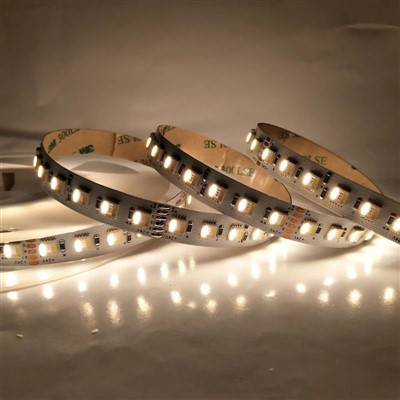

LightEmittingDiode, abbreviated as LED, the Chinese name is light-emitting diode. The LED strip refers to the assembly of LEDs on a strip-shaped FPC (flexible circuit board) or PCB rigid board, which is named after its product shape is like a strip. LED strips are divided into flexible LED strips and LED rigid strips. The differences are as follows:
1. The flexible LED strip uses FPC as the assembly circuit board, and uses SMD LEDs to assemble, so that the thickness of the product is only the thickness of a coin and does not take up space; the general specifications are 30cm long 18 LEDs, 24 LEDs and 50cm long 15 LEDs, 24 LEDs, 30 LEDs, etc. There are also 60cm, 80cm, etc., and different users have different specifications. And it can be cut at will, and it can be extended at will without affecting the light emission. The FPC material is soft, can be bent, folded, and wound at will, and can be moved and stretched in three-dimensional space without breaking. It is suitable for use in irregular places and places with small spaces, and because it can be bent and wound arbitrarily, it is suitable for any combination of various patterns in advertising decoration.
2. The LED rigid light bar is assembled with PCB rigid board, LED is assembled with SMD LED, and also with direct plug-in LED. Different components are used according to different needs. The advantage of the rigid light bar is that it is easier to fix, and it is more convenient to process and install; the disadvantage is that it cannot be bent at will and is not suitable for irregular places. There are 18 LEDs, 24 LEDs, 30 LEDs, 36 LEDs, 40 LEDs and many other specifications of SMD LEDs for rigid light bars; 18 LEDs, 24 LEDs, 36 LEDs, 48 LEDs are used for in-line LEDs. In different specifications, there are front and side ones, and the side-illuminated ones are also called Great Wall light bars.